

20 February, 2026
This is a comprehensive guide to the end of cash in Europe 2026, covering practical impacts, real scenarios, and preparation strategies for international travellers.

End of cash in Europe 2026 is no longer just a debate — it’s a shift that is quietly transforming how travellers pay, move, and plan their trips across the continent.
The first time I saw a café refuse coins in a small European town, I thought it was just modern fuss. Today, with the end of cash in Europe in 2026 becoming an ever-closer reality in public debate, the feeling is quite different: travelling across the continent is about to change quietly — and those who aren’t paying attention could find themselves in embarrassing, or worse, expensive situations.
Behind the scenes, banks, governments, and fintechs are accelerating changes that directly affect tourists. It’s not about paranoia, nor is it about conspiracy theories. It’s about how to pay for the metro in Berlin, split the bill in Lisbon, or buy a croissant in Paris without any nasty surprises.
Therefore, understanding this financial transition has ceased to be a mere curiosity and has become a crucial part of travel planning.
The end of cash in Europe 2026 is not about eliminating notes overnight, but about a steady transition towards digital payments that affects everyday travel decisions — from buying train tickets to paying in small cafés. Understanding how the end of cash in Europe 2026 unfolds helps travellers avoid friction and adapt confidently to new payment expectations.
What you will discover here:
- Why there’s so much talk about the end of physical cash
- How new banking laws impact tourists
- Real-life situations that could catch travellers off guard
- Countries where physical cash has already practically vanished
- Practical strategies for travelling without the headache
- What to expect in the coming years
Why the end of cash in Europe in 2026 has become a serious matter
There isn’t a “magic decree” abolishing notes and coins overnight. What’s happening is rather more subtle — and perhaps more effective.
A combination of three forces is accelerating the transformation:
- Anti-fraud and anti-money laundering regulations
- The digitalisation of banking systems
- A cultural shift in European behaviour
The debate has gained momentum with initiatives backed by institutions such as the European Central Bank and policies discussed within the European Union.
Furthermore, the digital euro project is in its testing phase, signalling a future with even more electronic payments. For tourists, this means adapting — and quickly.
Para entender melhor o contexto regulatório, vale consultar a To understand the regulatory context, it’s worth checking the official ECB page on digital payments..
What changes in practice with the digital transition
Travelling has always had its little rituals: exchanging currency, sorting notes, keeping coins in your coat pocket. That ritual is disappearing.
And it’s not just a matter of aesthetics.
1. Establishments that don’t accept physical cash
In cities like Stockholm or Amsterdam, it’s already common to spot discreet signs stating: “cashless only”.
This trend is set to spread. With the move towards a digital economy, tourists might encounter:
Museums that only accept cards or apps
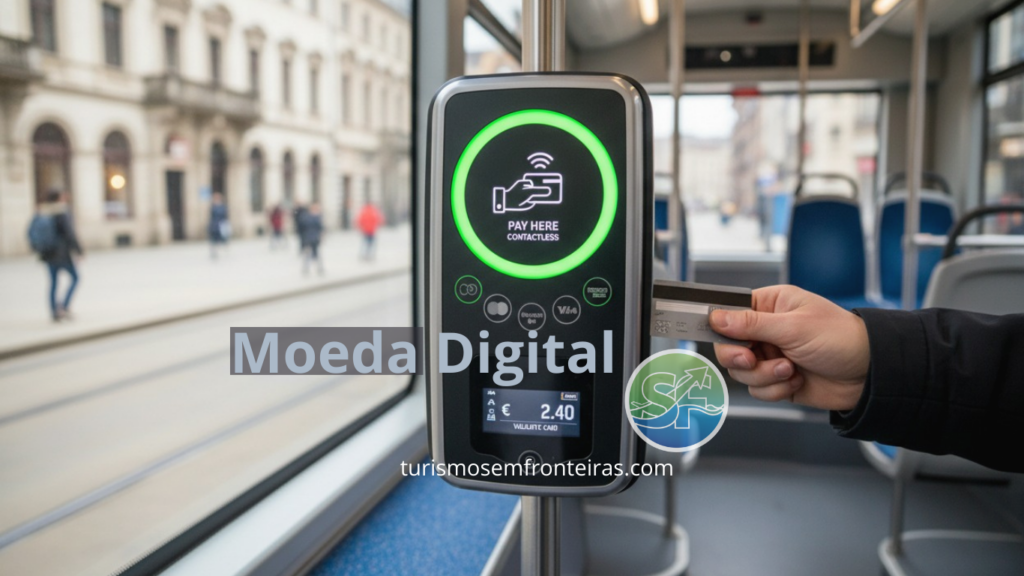
100% digital public transport — something you’ll quickly notice when using metro networks and buses, especially if you’re already planning your journeys in advance.
Imagine arriving exhausted after a long flight — the kind of fatigue that makes your body feel like solid concrete — only to discover your notes are useless, even when trying to pay for a simple meal in local neighbourhoods.
Stricter limits for cash payments
Several European countries have been lowering the legal limits for cash transactions.
Consequently, hotels, car rentals, and tours are requiring traceable payment methods. The current legislative trend firmly reinforces this move.
Increased scrutiny at borders and airports
Carrying large sums of cash already requires a declaration. With new rules, controls could become even stricter.
It’s not drama — it’s just administrative routine.

Countries where the cashless future already feels like reality
Some places are years ahead of the curve.
Sweden: the laboratory of the future
Less than 10% of transactions are made in cash. Churches accept card donations. Banks hardly deal with notes at all.
Travelling there is like getting a sneak peek of what’s to come across the continent.
The Netherlands: quiet digital efficiency
Contactless payments completely dominate. Many small establishments don’t even keep change in the till.
Finland and Denmark
Local apps are omnipresent. The shift doesn’t sound radical over there — just inevitable.
Real-life situations that could catch tourists off guard
The theory seems simple enough. The practice, it’s not
The taxi that doesn’t accept cash
More and more drivers prefer apps or cards. Some don’t even carry change.
The “too modern” neighbourhood market
Small businesses are adopting digital systems for security reasons. Hard cash is becoming the exception.
The confusing tip
Without coins, many travellers are left unsure of how to show their appreciation for good service. Apps and digital “round-up” features are replacing the classic gesture.
Comparison: Travelling to Europe (Before vs. After 2026)
| Feature | How it was until 2024 | Reality in 2026 |
| Coins | Essential for public loos and tipping. | Practically extinct; toilets accept contactless. |
| Euro cash | Accepted everywhere, but frowned upon for large amounts. | Rarely used; total focus on the Digital Euro and cards. e cartões. |
| Payment Method | Physical card or physical cash | Smartphone, Smartwatch, and Digital Wallets (Apple/Google Pay). |
| Small Businesses | Often required a minimum spend for cards. | 100% integrated into the digital system with no minimum spend. |
| Security | Risk of losing or having a cash-filled wallet nicked. | Greater security with biometric authentication on mobiles. |
How to prepare for a cashless European trip
Here is where the strategies that truly make a difference come in — the ones that help you avoid stress while jet lag is still having a row with your body clock.
Have multiple payment methods
- International chip and contactless card
- Digital wallet on your mobile (Apple/Google Pay)
- Backup travel card (like Revolut or Wise)
Redundancy is the operative word.
Inform your bank before travelling
Security blocks are incredibly common. There’s nothing worse than discovering this whilst in the queue for a train ticket.
Download local apps
In some countries, tickets and services simply work better via a dedicated app. This makes digital literacy almost mandatory for the modern traveller.torna isso quase obrigatório.
Prepare for invisible fees
Digital payments make life easier, but they can include:
- Automatic currency conversion (Dynamic Currency Conversion)
- Card issuer transaction fees
- Local taxes on foreign transactions
Proper planning prevents nasty surprises.
Security: the bright side of a cashless world
It’s not all just about making adjustments.
Less physical cash means:
- A lower risk of theft and pickpocketing
- Easier expense tracking via banking apps
- Greater ease during emergencies
Funnily enough, many travellers report feeling a greater sense of peace of mind.
The psychological impact of travelling without cash and coins
There is something almost ritualistic about paying with cash — a gesture that connects the traveller to the place.
Without it, the experience definitely changes.
Some feel the practicality. Others, a pang of nostalgia
This shift redefines that relationship, making the trip much more fluid, yet somehow less tangible.

Tips hardly anyone mentions about the new payment landscape
Here are the little details that rarely pop up in your standard guidebooks.
The internet is essential
Without a connection, digital wallets can fail. Make sure you have a local SIM or an eSIM.
Small amounts still exist — but are rare
A few markets or rural fairs might still accept cash, but honestly, I wouldn’t bank on it.
Emergencies require a plan B
Keep a small stash of euros tucked away, even with the growing shift to digital.
What to expect in the coming years
Experts believe the transition will be gradual. Physical money won’t vanish entirely, but its use will become purely marginal.
The 2026 milestone symbolises a cultural turning point — much more than just a definitive deadline.
Smart planning: integrate this into your itinerary
Before boarding:
- Review your digital payment methods
- Check your card limits for international use
- Understand local payment policies
Real cases from the road: when cash doesn’t solve it
A traveller once mentioned trying to pay for a coffee in Copenhagen with notes — the barista apologised, pointed to the “card only” sign, and smiled with that almost disconcerting Nordic politeness.
Another reported being unable to use coins at a ticket machine in Vienna.
These little episodes show just how much the digital-first approach is already part of everyday life.
The cultural side: tradition versus innovation
Historic markets, centuries-old bakeries, and street fairs still preserve the rustic charm of physical money. However, the relentless march of technology is pushing forward.
Europe has always brilliantly balanced the past and the future. Now, it’s doing the same with how we pay.
What this means for international travellers
Tourists often carry euros in cash for safety. That habit now needs a bit of a rethink.
With the end of cash in Europe in 2026, the focus inevitably shifts to digital financial planning — and getting your head around international banking fees and travel-friendly cards.
As the end of cash in Europe 2026 continues to reshape financial habits, travellers who prepare early will enjoy smoother experiences, fewer surprises, and greater confidence navigating a rapidly evolving payment landscape.
Conclusion: travel prepared for the new financial landscape
Travelling has always been about adapting — time zones, languages, local customs. Now, the payment system has officially joined that list.
Understanding the end of cash in Europe in 2026 isn’t alarmism; it’s smart travelling. Those who prepare can wander about with peace of mind, avoid those dreadful travel hiccups, and make the most of every experience, be it an impromptu dinner, an unexpected train ride, or that museum you decided to visit at the very last minute.
If this topic caught your eye, share it with someone planning a trip and let us know in the comments: would you feel comfortable travelling without physical cash?
2 thoughts on “What Really Changes With the End of Cash in Europe — And Why You Need to Prepare”