
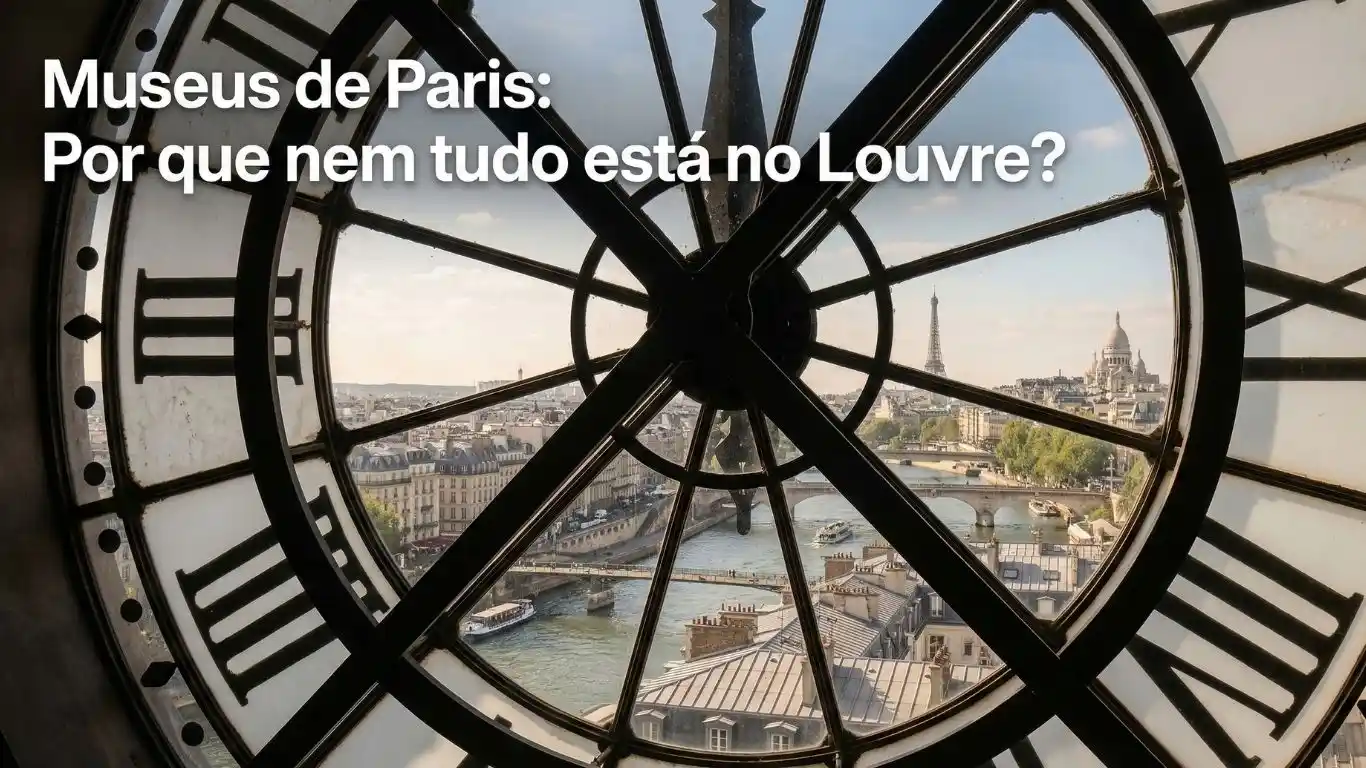
Paris seen from a privileged vantage point: the magic of the Musée d’Orsay.
When planning a cultural itinerary through France, the Louvre is almost always the first name that springs to mind. However, Paris museums offer so much more than just the home of the Mona Lisa. While the Louvre remains the beating heart of world art history, the French capital provides a cultural variety so vast that focusing solely on one location might be a bit of a strategic blunder for your international trip.
Paris doesn’t just house art; the city breathes creativity at every corner, square, and boulevard. From majestic palaces converted into galleries to avant-garde spaces of contemporary architecture, the City of Light is an open-air museum. As such, limiting yourself to a single visit to the Louvre might prevent you from discovering collections that are equally impressive and, quite often, offer a far less crowded and much more intimate experience.
If you are looking for true “travel without borders” through the European artistic universe, you need to broaden your horizons. Prepare to discover why the true essence of French art requires you to venture well beyond the glass pyramids.
The Louvre: The Giant Narrating Human History
The Louvre Museum functions as a colossal encyclopaedic book, filled with fundamental chapters on the foundation of our civilisation. Before becoming the most visited museum in the world, this immense complex was a medieval fortress and, later, the primary residence of the Kings of France. It guards essential works dating from ancient civilisations to the mid-19th century. In other words, anything classic, historic, and monumental usually has its place guaranteed there.
Inside this immense palace, which requires days (or even weeks) to be fully explored, you will find stars that have shone for centuries:
- Mona Lisa (La Joconde), Leonardo da Vinci’s enigmatic portrait;
- Venus de Milo, the definitive symbol of Ancient Greek aesthetic perfection;
- Liberty Leading the People by Eugène Delacroix, the quintessential image of the French Revolution;
- The Winged Victory of Samothrace, an imposing sculpture that dominates the museum’s main staircase.
However, the Louvre organises its works by specific civilisations and historical periods. Each room is a chapter of world history — stone by stone, brushstroke by brushstroke.
But herein lies the big question for the modern traveller: if you’re looking for something different from rigorous classicism, where is the rest of the art? Where are the rebellious brushstrokes, the pure colours, and the forms that challenge the mind? This is exactly where the other incredible Paris museums come into play.
The Art Timeline: Why Venture Beyond the Big One?
The answer to the need for exploring beyond the Louvre lies in the timeline of artistic evolution itself. The Louvre’s collection covers history masterfully, but only up until the year 1848. From that date onwards, the art world began to change drastically. Artists started breaking academic rules and transforming painting and sculpture into what we now know as modern and contemporary art.
Thus, to see the seamless continuation of this fascinating story, you literally need to cross the River Seine. Furthermore, exploring smaller, more focused institutions allows for a much calmer and more profound sensory experience. You’ll be far from the frantic crowds that huddle daily just to snag a famous photo. Therefore, it is well worth opening the city map and discovering what is hidden within the charming Parisian neighbourhoods.
Musée d’Orsay: A Jewel Among Paris Museums
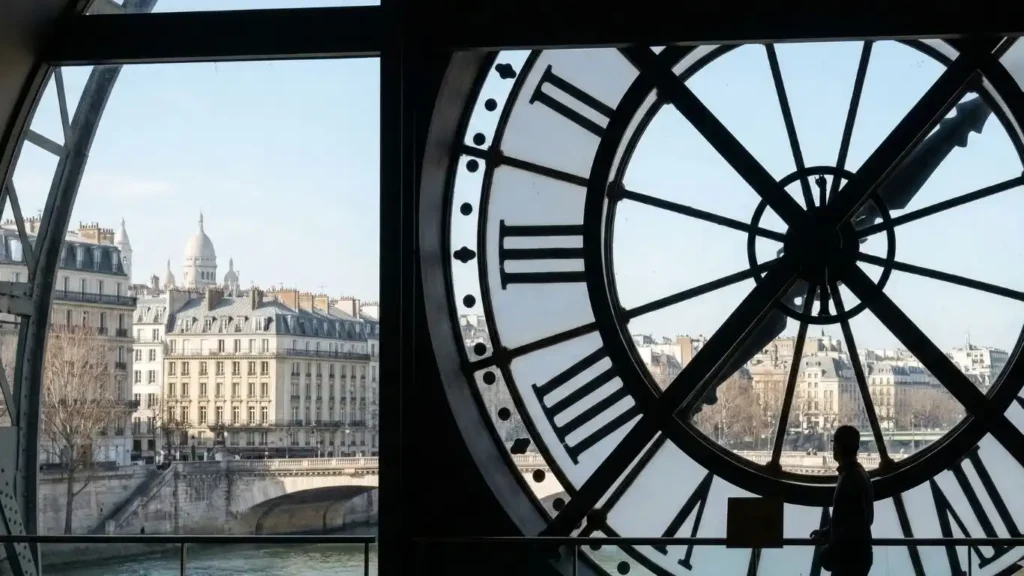
If the Louvre is the definitive museum of ancient and classical history, the Musée d’Orsay is the sanctuary of emotion, colour, and light. Located in a stunning, converted former railway station built for the 1900 Universal Exhibition, it proudly houses the largest and richest collection of Impressionist and Post-Impressionist paintings in the entire world.
There, the rigid and somber rules of the past were cast aside. Imagine the vibrant atmosphere of a lively conversation in a Parisian café during the Belle Époque: everything is lighter, bolder, and more alive. Instead of posed portraits of untouchable kings and mythological gods, you will see daily life, natural landscapes, and vibrant colour palettes take centre stage.
- Vincent van Gogh and his iconic Starry Night Over the Rhône and his Self-Portrait;
- Claude Monet and his poppy fields and luminous gardens;
- Pierre-Auguste Renoir and the festive, dancing Bal du moulin de la Galette;
- Edgar Degas with his famous and delicate ballerinas.
Beyond the formidable works, the building’s architecture itself is breathtaking. The massive transparent clock on the top floor offers one of the most photogenic views of Paris, framing the Sacré-Cœur Basilica in the distance. Consequently, visiting the d’Orsay is to understand exactly how modern art was born and took its first steps. It is an absolute must-stop for anyone wishing to masterfully complete the circuit of Paris museums.
Centre Pompidou: The Audacity of Modern Art
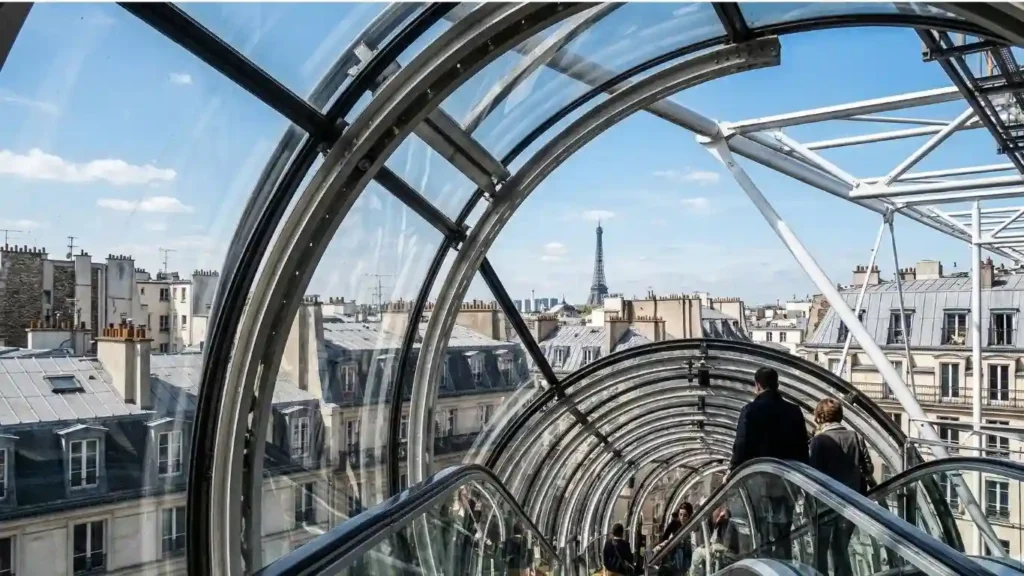
While the Louvre looks back at a glorious past and the d’Orsay records the transition of light, the Centre Georges Pompidou (also known as Beaubourg) looks directly and fearlessly towards the future. Its disruptive external architecture, designed by Renzo Piano and Richard Rogers, caused quite a shock when it opened. With its colourful external pipes (blue for air, green for fluids, yellow for electricity, and red for circulation) and escalators visible in glass tubes, the building warns visitors immediately that the content inside is unlike anything else in the city.
This innovative space is home to the National Museum of Modern Art, covering the most diverse artistic expressions from the 20th century to the present day. Upon entering, abandon any expectation of finding only classical paintings hanging neatly on the wall. In contrast, you will see interactive installations, video art, recorded performances, and thought-provoking forms that challenge logic and provoke critical thinking.
The collection features unquestionable geniuses of modern thought, such as:
- Pablo Picasso and his Blue and Cubist periods;
- Wassily Kandinsky and his purely abstract compositions;
- Marcel Duchamp and his controversial readymades;
- Joan Miró and his dreamlike forms.
If you enjoy the experimental, design, architecture, and cultural avant-gardes, this is undoubtedly one of the best Paris museums to include in your strategic itinerary immediately. Not to mention the rooftop terrace, which provides one of the most impressive 360-degree views of the city, taking in the Eiffel Tower, Notre-Dame, and those charming Parisian zinc rooftops.
A Sanctuary of Peace at the Musée de l’Orangerie
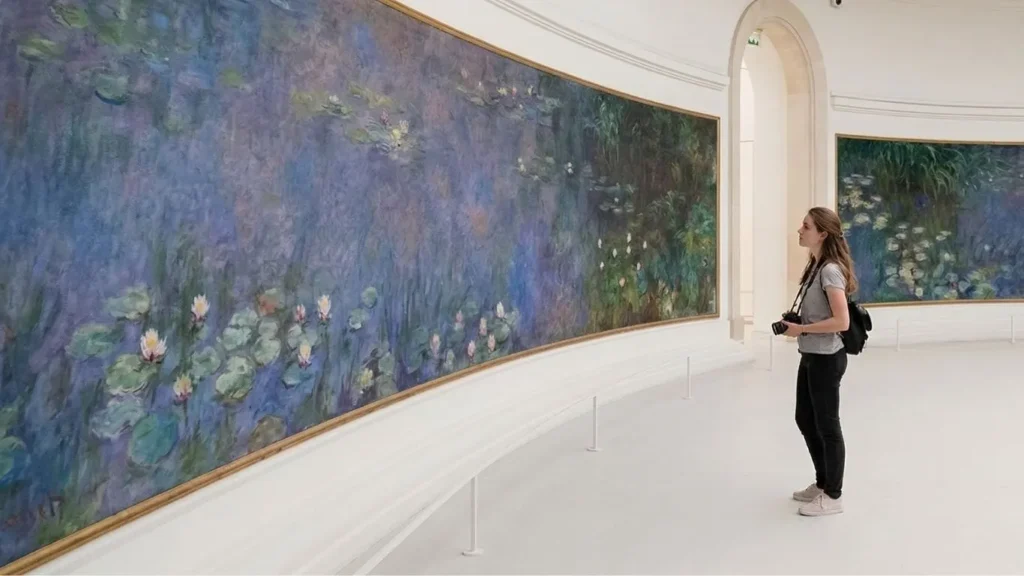
The list of exceptional cultural options in the French capital is almost endless. Beyond the three giants mentioned above (Louvre, d’Orsay, and Pompidou), there are highly specific museums that offer unforgettable and incredibly intimate experiences. If your goal is to escape the noise and find the pure essence of Impressionism in its most contemplative state, the answer lies in the Musée de l’Orangerie.
Situated at the edge of the beautiful Tuileries Garden, facing the Place de la Concorde, this building—once used to grow oranges—is the definitive and exclusive home of Monet’s famous and grand Water Lilies (Les Nymphéas). These are gargantuan, curved panels painted in the final years of the artist’s life, when he was already suffering from cataracts, which completely envelop the visitor.
Entering the two white oval rooms under the diffused natural light—designed according to Monet’s own requests—it is impossible not to feel an atmosphere of absolute peace, of almost meditative contemplation. It is an oasis of serenity amidst the chaos of a vibrant metropolis. In addition to this immersive Impressionist masterpiece, the Orangerie’s basement houses a rich collection of works by Renoir, Cézanne, Matisse, and Picasso (the formidable Walter-Guillaume collection).
Sculpted Romanticism at the Musée Rodin
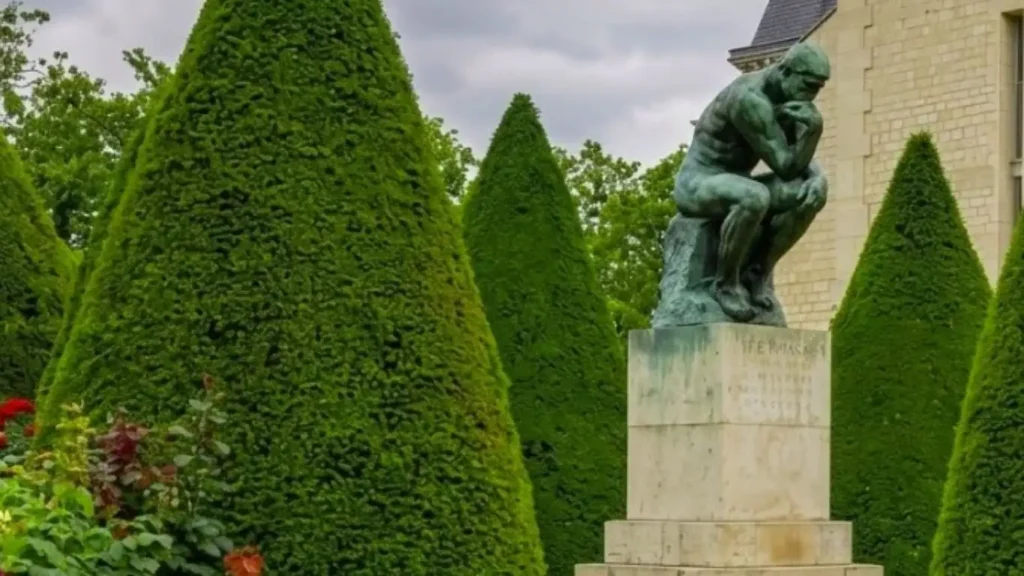
Still looking to diversify and deepen your itinerary? Next, the Musée Rodin deserves a spotlight in your cultural planning. Located in the Hôtel Biron (a majestic 18th-century mansion where the sculptor Auguste Rodin lived and worked in his later years), this space is fundamentally different from the vast galleries and dim corridors of other institutions.
A large and wonderful part of its rich collection of classical sculptures is scattered and harmoniously integrated throughout a stunning French garden, filled with roses in bloom during the spring and a serene pond. Wandering unhurriedly among massive bronze sculptures, such as the colossal The Gates of Hell (inspired by Dante’s Divine Comedy), the controversial Balzac, or sitting on a bench near The Thinker while feeling the fresh outdoor breeze, is a unique and singularly relaxing experience.
The garden-only ticket is an extremely economical and peaceful alternative, perfect for an impromptu romantic picnic or simply to rest weary legs after long walks through the Quartier Latin or Invalides. And if you decide to explore the mansion’s interior, be sure to admire the section dedicated to the brilliant and tragic Camille Claudel, whose emotional and sensitive sculptures engage in an eternal silent dialogue with those of Rodin, with whom she had a passionate and destructive relationship.
Belle Époque Grandeur at the Petit Palais
For those seeking a hidden gem filled with indescribable luxury and beauty, the Petit Palais (City of Paris Museum of Fine Arts) is an unmissable secret that often escapes the radar of the first-time tourist. Also built for the grand 1900 Universal Exhibition, its Beaux-Arts façade is incredibly ornate, and its central staircase practically invites you inside.
Beyond housing beautiful Impressionist paintings and refined period furniture, the absolute highlight for your travel experience is that entry to the permanent collection is completely free all year round. That’s right; you can enjoy first-rate art, frescoed ceilings, and a majestic, luxurious café in the internal courtyard with a decorative pool without spending a single Euro.
When planning your journey through these artistic wonders, organisation is the key difference between pure enchantment and total exhaustion. Visiting Paris museums requires a bit of strategy to ensure you don’t spend your precious holiday time in endless queues. Check out these crucial tips:
Buy Tickets in Advance (and Online)
For all the main Paris museums, buying your ticket in advance online is not just recommended; it is practically mandatory. The Louvre and the d’Orsay frequently operate at full capacity with timed entry slots. Arriving without a ticket is a recipe for guaranteed frustration or, at best, hours lost in a queue outside the building.
Consider the Paris Museum Pass
If you are an art aficionado planning to visit many of the Paris museums mentioned above on consecutive days (two, four, or six days), purchasing the Paris Museum Pass could be your smartest financial decision. More importantly, it acts as your VIP fast-track entry. It grants free access to over 50 museums and monuments in and around the French capital (including Versailles). However, remember that for the most popular sites (like the Louvre), even with the pass, you must still book a mandatory time slot on the official website days in advance.
Pay Attention to Closing Days and Late Openings
- Tuesdays: The Louvre, Pompidou, and Orangerie are usually closed on this day for maintenance, causing significant crowds in the other open spaces across the city. Be mindful of this.
- Mondays: The d’Orsay and Rodin close their doors for a rest, which can throw a spanner in the works for those who usually start their week focused on Paris museums.
- Late Openings (“Nocturnes”): This is the “pro-tip” for a spectacular visit! On specific days of the week, several Paris museums extend their opening hours until 9:45 pm. The Louvre stays open late on Fridays, and the d’Orsay on Thursdays. These slots usually have fewer tours, no noisy school groups, and the lighting is much warmer and more atmospheric.
Take Advantage of Free Entry Days
In the past, most major Paris museums offered free entry on the first Sunday of every month. However, be aware that rules have been changing post-pandemic to reduce massive crowding. The Louvre now restricts free entry to specific evening periods or the low season for certain visitors, while smaller museums like the Orangerie and d’Orsay still maintain the Sunday tradition—though booking in advance to secure your spot on these free Sundays is absolutely indispensable.
Conclusion: A Journey Beyond the Obvious
In short, a leisurely visit to the iconic Louvre Museum is essential and unforgettable at any stage of life, but see it merely as the fascinating start of your journey through centuries of aesthetic sensibility. Living culture breathes outside those classical walls and extends through every district.
To understand the true and genuine artistic soul of contemporary, romantic, and revolutionary France, allow yourself the invaluable privilege of exploring the wealth contained within the many other great (and small) Paris museums. Planning this unforgettable immersion well in advance with detailed and reliable information—focusing on more than just the big crowds—helps build an international itinerary that is significantly smarter, substantially less tiring, and, without a doubt, absolutely transformative. Art, after all, requires no rush; it asks for a brave dive into the beautiful.
Finally, to plan your visit with updated times and advance ticket purchases, we recommend consulting the official local tourism site, Paris Je t’aime, which offers detailed information on all temporary exhibitions and cultural passes.
Final Tip
In essence, the Louvre is essential, but it is only the beginning of the journey. To understand the true artistic soul of France, allow yourself to explore the various Paris museums. Planning this immersion in advance helps create a smarter, less tiring, and absolutely unforgettable itinerary.
Learn More: After appreciating the masterpieces inside the museums, why not discover the gems on the streets? Check out this walking tour of Parisian architecture and fall in love with every detail of the City of Light.
See Also:

2 thoughts on “Paris Museums: Why the Louvre is Just the Tip of the Iceberg”