
You know that exact, fleeting moment when the chaotic world just clicks seamlessly into place?
For me, it happened on a damp Tuesday afternoon. I was standing on a street corner, a warm, perfectly flaky butter pastry crumbling gently in my hand. A bitter autumn wind whipped off the River Seine, biting at my cheeks. Above me, my eyes locked onto a weathered stone gargoyle that seemed to genuinely mock the frantic, scurrying tourists below. To be completely candid with you, the authentic, breathing Paris does not exist in the three-hour queues for the Louvre. It lives in the physical friction of the city. Discovering the soul of Paris on foot means listening to the sharp, uneven crack of ancient cobblestones beneath your boots and tracing the intricate, swirling shadows cast by wrought-iron balconies against a bruising grey-blue sky.
Designing a walking route is, before anything else, an act of sheer rebellion against the tyranny of the clock. It is the conscious decision that a thoroughly ordinary, unnamed residential facade in the Marais district demands just as much of your reverence as the towering iron lattice of the Eiffel Tower.
Having wandered through the suffocatingly preserved ash of Pompeii, navigated the frantic, towering grids of New York, and braced against the biting, horizontal rain of Scotland, I can tell you this: Paris demands a completely different rhythm. What truly hypnotised me on my most recent journey was the profound realisation that this capital is not a museum. It is a living, breathing organism. The honey-coloured Lutetian limestone, quarried centuries ago, still seems to exhale under the heavy, amber light of the late afternoon sun. In this guide, we are not simply going to “visit landmarks” like passive spectators. We are going to decipher the deep scars, the bloody revolutions, and the soaring aesthetic triumphs carved directly into the walls of the French capital. Lace up the most forgiving, heavily cushioned trainers you own. We are going deep into the gritty history and the vibrant daily reality of the City of Light.
The Beating Heart: Where Paris Learnt to Be a Giant
Think the city started with grand, sweeping palaces and manicured lawns? Think again. It started with mud, river water, and a stubborn Celtic tribe.
Our walk commences on the Île de la Cité. This tear-drop-shaped island in the middle of the Seine is the literal cradle of the city, the exact patch of damp earth where the Parisii tribe decided to drive their wooden stakes into the ground around 250 BC. As you cross the bridge and step onto the island, the wind shifts. It is impossible not to feel a sudden, sharp knot in your stomach when confronting the imposing, battered silhouette of the Notre-Dame Cathedral. Even now, wrapped in scaffolding and still recovering from the catastrophic inferno of 2019, she radiates a heavy, physical resilience that catches in your throat. You can smell the scent of fresh sawdust mingling with the eternal dampness of the river. The men and women in hard hats working high up on those precarious platforms today are the direct, spiritual descendants of the medieval artisans who, back in the 12th century, spent two gruelling centuries pulling these twin towers into the sky. Close your eyes. Imagine the deafening ring of iron chisels smashing against solid rock under the strict, unforgiving command of Bishop Maurice de Sully.
But here is the real secret that the guidebook-clutching masses miss: while everyone stands frozen, staring up at the western facade, you need to keep walking. Go around to the back.
Look closely at the massive, sweeping stone arches propping up the choir—the legendary flying buttresses. They look like the ribs of a giant, sleeping beast. They are absolute proof that earth-shattering beauty is often born out of pure, desperate necessity. Without those external, spider-like “legs” of solid masonry, the soaring, impossibly thin Gothic walls would have instantly collapsed under the crushing, sheer weight of the heavy lead roof. It is medieval engineering masquerading flawlessly as high art.
However, the greatest treasure of this island is hidden entirely out of sight.
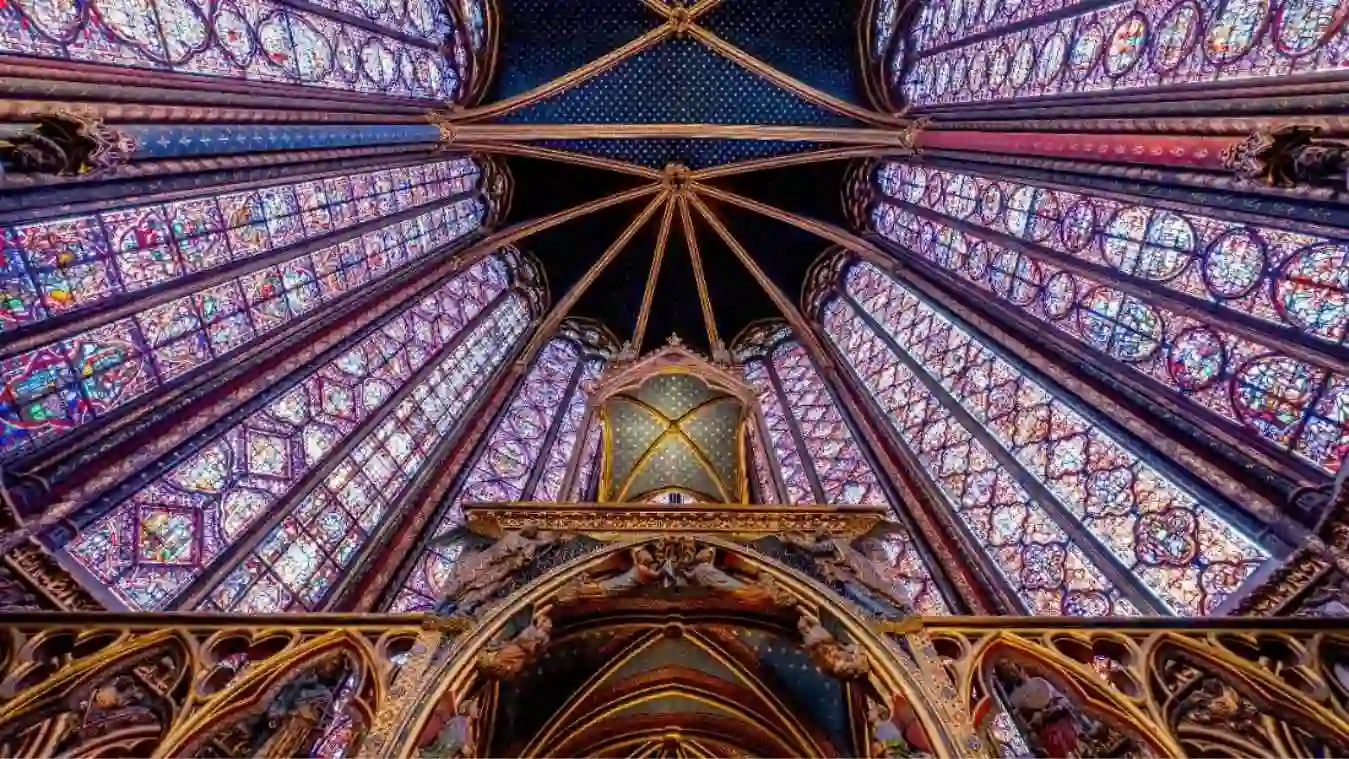
Just a few hundred yards away, completely swallowed by the austere, intimidating fortress walls of the Palais de Justice, lies the Sainte-Chapelle. If Notre-Dame represents raw, muscular power, the Chapelle is the fragile, glittering jewel in the crown. I mean that literally. It was commissioned by King Louis IX specifically to house what he believed to be the Crown of Thorns worn by Christ. When you squeeze up the claustrophobically narrow, worn spiral staircase and finally emerge into the upper chapel, the physical impact hits you like a shockwave. It is akin to stepping directly into the belly of a colossal, illuminated kaleidoscope.
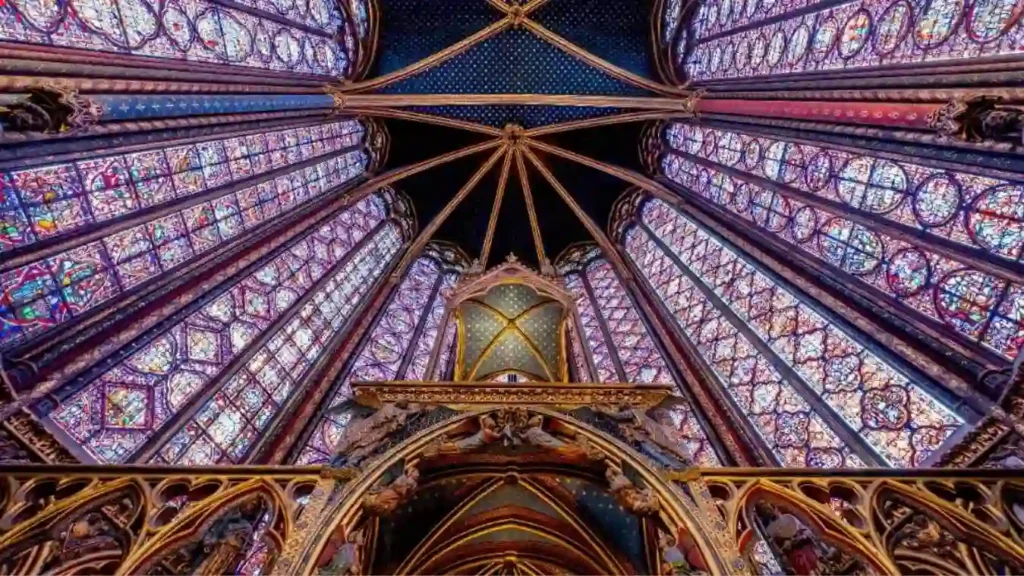
The 13th-century stained glass windows do not function as mere windows. They are colossal, glowing medieval comic books designed for a filthy, impoverished population that could not read a single word. The way the afternoon light forcefully pierces the deep ruby reds and sapphire blues creates a thick, heavy spiritual atmosphere that commands total silence, regardless of your personal beliefs.
The Transition to Luxury: From Gothic to Neoclassical
What if I told you that the oldest standing bridge in the entire city is ironically named the “New Bridge”?
As you leave the island and cross the Pont Neuf, do not let the misleading title fool you. Henri IV ordered its construction in the late 16th century. What I find endlessly fascinating here are the mascarons. Lean over the stone parapet and look at the sides of the arches. There are 381 uniquely carved stone faces staring back at you. Historians claim they represent the sneering courtiers of the King’s inner circle, but to me, with their twisted expressions and eroded noses, they just look like battered old friends quietly watching the dark, swirling waters of the Seine rush by. Stop here. Rest your elbows on the cold stone. It is a spectacular vantage point to watch the sky turn violently pink while the harsh, blinding spotlights of the tourist boats slice through the twilight.
Walking away from the river and towards the Louvre forces a brutal shift in your mental frequency. We leave behind the dark, religious intimacy of the Middle Ages and smash headfirst into the arrogant grandiosity of absolute monarchy.
The museum complex, which brutally evolved from a defensive medieval fortress into a sprawling royal palace, serves as an intimidating masterclass in neoclassical architecture. Stand in the Cour Carrée. The absolute, mathematical symmetry of Perrault’s Colonnade feels like a strict command to stand up straight. Yet, to truly understand the schizophrenic nature of Parisian architecture, we must turn our attention to the glass elephant in the courtyard: I.M. Pei’s Pyramid.
Do you want to know the most brilliant part of this entire structure?
When it was proposed in the 1980s, the French public practically rioted. Critics called it an atrocious, space-age scar on the face of their beloved history. Today, it stands as the ultimate symbol of a capital that aggressively refuses to be trapped in the past. It functions as a massive, geometric mirror. The ultra-modern, transparent glass panels perfectly reflect the ornate, heavy stone facades of the 16th-century pavilions. It is an argument between the old and the new, frozen in time.
The Lungs and the Historical Axis
You might reasonably assume that a public garden is just a collection of trees and some grass. Here, landscaping was a weapon of absolute power.
Keep walking west and enter the Jardin des Tuileries. Masterminded by André Le Nôtre, the same obsessive genius who tamed the wild swamps of Versailles, this expansive park defines the “jardin à la française”. Everything here is an exercise in violent control over nature. Geometry rules over chaos. The wide, dusty gravel paths are so aggressively straight that, on a clear day, you can stand by the central fountain and see the Arc de Triomphe looming far away on the horizon. This unbroken line of sight is famously known as the Historical Axis.
My golden piece of advice: do not just march through this park like it is a shortcut.
Seek out one of those heavy, iconic green metal chairs scattered around the water basins. Pull it up to the edge. There’s a rustic, enduring honesty to their utilitarian design, reminding me vividly of the simple, striking beauty I once tried to capture on canvas when painting an oil study inspired by Van Gogh’s yellow chair—a masterpiece made from the utterly mundane. Sit down. Stretch your aching legs. The sheer democracy of this space is staggering. You will see a stressed, sharply dressed investment banker eating a cheap sandwich right next to a broke university student reading poetry, both seeking refuge under the massive, cooling shade of centuries-old chestnut trees. The staggering beauty of this place is violently free, and that accessibility is precisely what makes Paris so deeply human.
Haussmann’s Revolution: The Look We Love
Imagine an intensely focused, ruthless man who looked at a chaotic, disease-ridden medieval maze and calmly decided to bulldoze the entire lot of it.
Now, we shift the tempo entirely. When you close your eyes and conjure an image of a romantic Parisian street, you are not dreaming of history; you are dreaming of Baron Haussmann. Prior to 1850, the city was a dark, festering labyrinth of impossibly narrow, sewage-filled alleys. Cholera was rampant. Napoleon III, desperate for a clean, modern capital (and secretly wanting wide, straight roads that were much easier to control with military artillery during riots), handed Haussmann a terrifying mission: gut the city. He ruthlessly demolished thousands of ancient homes, displacing the poor, to violently carve out the grand, sweeping boulevards we worship today.
This specific architectural uniformity is where the city truly captured my imagination.
The Haussmannian apartment blocks stand shoulder-to-shoulder like disciplined soldiers on a military parade. They are strictly constructed from that same Lutetian limestone, demanding a uniform height. Look closely at the strict rules of the facade: continuous, ornate wrought-iron balconies are only permitted on the second floor (the “noble” floor for the wealthy) and the fifth floor. It creates an elegant, sweeping visual monotony that induces an incredible sense of calm. To witness this grand, sweeping vision at its absolute, arrogant peak, walk towards the Opéra Garnier.
The Opéra is the physical embodiment of grotesque, fabulous exaggeration. The Beaux-Arts style throws out the rulebook and aggressively mixes everything together: heavy Baroque flourishes, delicate Renaissance symmetry, and a heavy dose of pure, theatrical madness. The gilded bronze sculptures on the sweeping roof look as though they might suddenly detach and fly away. If you have twenty spare minutes, buy a ticket just to stand on the Grand Staircase. The cold marble under your hands and the cavernous, echoing acoustics transport you back to the 19th century. This staircase was not built for people to access their seats; it was a stage for the ruthless high society of the Belle Époque to fiercely judge one another.
Art Nouveau: The Rebellion of Organic Forms
Straight lines are a sin against nature. At least, that was the furious battle cry of a new generation of architects in the 1890s.
They looked at Haussmann’s strict, mathematical grids and yelled, “Enough!” This explosive frustration birthed Art Nouveau. They demanded that buildings should grow and twist like organic plants, utilising sensual curves, stained glass, and massive amounts of heavily manipulated iron.
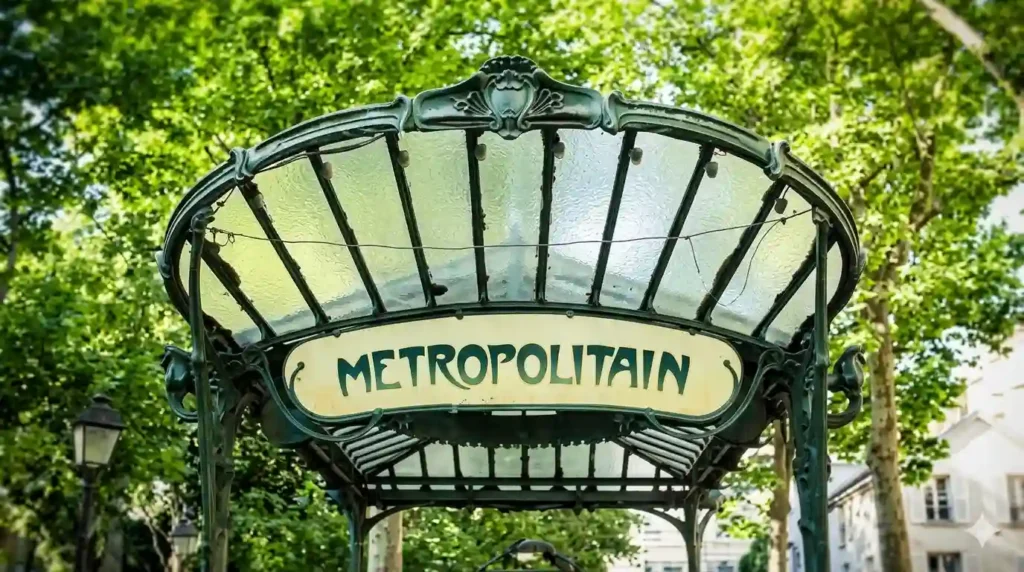
The most universally accessible, brilliant example of this rebellious phase is literally scattered beneath your muddy shoes: the Paris Metro entrances brilliantly designed by Hector Guimard. Approach one of those bizarre, green cast-iron structures. Run your hand over the cold metal. It does not look like a functional staircase; it looks like the twisting vines of a toxic, exotic jungle plant dragging you underground. The Abbesses station, tucked high up in the village of Montmartre, features one of the few surviving original glass canopies. Standing beneath it in a light drizzle, it looks exactly like the delicate, veined wings of a massive dragonfly shielding you from the damp.
And since we are on the subject of controversial ironwork, we cannot possibly ignore the looming “Iron Lady”.
When Gustave Eiffel dropped his colossal, alien structure onto the Champ de Mars for the 1889 World’s Fair, the cultural elite were violently disgusted. Famous writers circulated petitions demanding the immediate destruction of this “iron monster”. The 2.5 million rivets and the exposed, skeletal lattice offended their delicate, classical sensibilities. Today, try to imagine the global skyline without it. It stands as roaring, undeniable proof that brutal, utilitarian industrial engineering can seamlessly evolve into a nation’s most romantic poetry.
The Post-War and the Shock of the New
If you thought a massive iron tower caused a fuss, you should read the newspapers from the 1970s. Paris absolutely refuses to freeze and die like a taxidermy display.
If you want to experience the jarring, violent shock of what architects in the 1970s believed the distant future would look like, march yourself to the Centre Pompidou. Dropped right into the middle of the fiercely historic, delicate Marais district, it looks like a colossal, multi-coloured oil refinery that got lost and parked on a medieval street.
But do you know what? I absolutely adore the Pompidou. Renzo Piano and Richard Rogers did something wildly arrogant: they took the guts of the building and ripped them out. All the functional piping is aggressively bolted to the exterior. The giant tubes are colour-coded for your convenience: bright blue for the air conditioning, vibrant green for the plumbing, and screaming yellow for the electrical wires. This mad, industrial exoskeleton left the interior completely hollow, creating massive, uninterrupted voids for modern art. It is fiercely honest, aggressively loud, and totally out of the box. It represents the gritty, unyielding Parisian resilience to constantly reinvent itself, no matter who it offends.
If you crave something even more brutally massive, catch the yellow Metro Line 1 all the way out to La Défense. When you emerge from the ground, you are confronted by the Grande Arche. It is a colossal, hollow cube of glass and marble, so outrageously large that the entire Notre-Dame cathedral could fit comfortably inside its empty centre. It perfectly anchors the extreme, modern end of that Historical Axis we saw back at the Louvre. It is the ruthless, corporate face of the city, reflecting the cold clouds in its glass panels, confidently reminding you that this is still a terrifyingly powerful global financial centre.
Covered Passages: The Best-Kept Secret
It is absolutely pouring with rain, your socks are sodden, and you think your afternoon of exploring is completely ruined. It isn’t.
For a sudden, quiet moment of pure, cinematic nostalgia, you need to actively hunt down the Passages Couverts. These hidden, twisting corridors are the forgotten grandfathers of the modern shopping mall, but executed with a thousand times more grace and class. Smashed through the middle of existing buildings in the early 19th century, these narrow arcades were brilliantly capped with soaring glass roofs. This allowed the fabulously wealthy bourgeoisie to flaunt their expensive silk outfits and shop for exotic goods without dragging their hems through the disease-ridden mud of the open streets.
The Galerie Vivienne is, without question, my absolute favourite sanctuary in the city. When you push through the heavy wooden doors, the noise of the traffic simply vanishes. The incredibly complex, geometric mosaic tiles crunch softly beneath your feet. The heavy, comforting scent of roasting coffee beans clashes with the dusty, vanilla smell of ancient paper spilling out of the old bookstores. It is the ultimate location to embrace a luxurious disaster: when the inevitable Parisian downpour traps you, retreat in here. Order an overpriced, scalding pot of Earl Grey tea, sit back against the wooden panelling, and simply listen to the heavy rain drumming frantically against the glass roof far above you. You will genuinely find yourself thanking the heavens for the dreadful weather.
Practical Guide: How Not to “Die” Along the Way
Let’s get one thing incredibly straight before you book your flights: this city will physically break you if you approach it with naive arrogance.
Footwear is a Religion: Delete the glamorous, cinematic fantasies from your brain right now. You are not starring in a romantic comedy. Paris is a brutal obstacle course of uneven, slick cobblestones, hidden curbs, and endless, steep metro stairs. Wear proper, highly cushioned running trainers. Your feet are your primary engine; treat them with deep respect.
The Gift of Free Water: Keep your eyes peeled for the Wallace Fountains. They are those deeply ornate, dark green cast-iron structures featuring four caryatids holding up a small dome. The water that flows from them is perfectly safe, remarkably cold, and completely free. It is a brilliant, quiet gift from the city administration to keep you moving.
Force Your Chin Up: The vast majority of tourists walk around hunched over, staring blindly at the glowing blue dot on Google Maps or pressing their faces against luxury shop windows. The genuine architectural treasure hunt begins strictly above the first floor. Look up. The intricate, angry stone sculptures, the precarious slate roofs, and the tiny, romantic mansard windows hide eccentric stories that the sterile, brightly lit boutiques at ground level could never comprehend.
Respect the Local Velocity: Do not attempt to aggressively tick off twenty sights in eight hours. Paris is meant to be digested slowly, like a heavy, rich meal. If you pass a tiny, battered café with a fogged-up window and it calls out to you, stop walking. Sit down. Order an espresso. The Gothic cathedrals and the iron towers have stood there for centuries; I assure you, they are not going anywhere.
Video Suggestion for Your Immersion
To aggressively expand your visual understanding of the brutal and beautiful transitions we have just dissected.
Furthermore, for the obsessive history purists who genuinely wish to dig through the dry, official documentation, I suggest translating and navigating the official portal for the French Ministry of Culture or the Centre for National Monuments. There, you can discover the incredibly dense, technical blueprints detailing the ongoing, painstaking restoration of both Notre-Dame and the Sainte-Chapelle
The Counterintuitive Detail (Information Gain)
Every single generic travel blog on the internet will aggressively order you to queue for three hours to reach the summit of the Eiffel Tower for the “ultimate view”. I am explicitly telling you to completely ignore that consensus: absolutely do not go up the Eiffel Tower.
Do you want to know the glaringly obvious reason why?
Because when you are standing freezing at the very top of it, you cannot actually see the single most beautiful, iconic structure in the entire Parisian skyline… because you are standing inside it!
Instead, walk directly to the massive department stores, Galeries Lafayette or Printemps. Take the series of escalators all the way up to their free, open-air rooftop terraces. The panoramic view costs you absolutely nothing. You get the opulent, golden roof of the Opéra Garnier dominating the foreground, and the sweeping, romantic silhouette of the Eiffel Tower perfectly anchoring the distant horizon. It is a wildly more authentic, far less claustrophobic experience. Plus, it allows you to smartly pocket that 25-euro ticket fee and violently redirect those funds towards a massive, heavily garlic-buttered serving of escargot at a noisy, authentic local brasserie.
Final Reflection
Walking relentlessly through the changing districts of Paris is a masterclass in understanding that aesthetic beauty is not some frivolous, expendable luxury. It is a deeply ingrained, fundamental requirement for the human soul. Every identical, honey-toned Haussmannian block, every shattering explosion of colour in a Gothic stained-glass window, and every twisting, green iron vine at a metro station serves as a permanent, physical reminder that humanity is capable of building things that fiercely endure and aggressively inspire.
The next time you find yourself dropped into the middle of the French capital, do something radical: fold up the map and stuff it in your pocket. Willingly allow yourself to get hopelessly, utterly lost down a dark, curving alleyway in the Latin Quarter. Take a minute to listen to the gruff voice of the old man who has been selling battered paperback books from the same green metal box on the riverbank for forty unbroken years. Yes, Paris is constructed from cold stone and heavy iron, but its blood only truly circulates through the frantic, beautiful chaos of its people.
So, which specific era of stone and steel makes your pulse race faster? The terrifying, divine verticality of the Gothic masters, or the sweeping, militant elegance of Haussmann’s urban surgery? Let me know down in the comments below. And if you have stumbled across a quiet, crumbling courtyard that no one else has noticed, leave the secret coordinates for the rest of us. After all, the absolute greatest thrill of travelling is the sudden, dizzying realisation that the world is infinitely more complex and deeply layered than our guidebooks ever dared to admit.
Your boots are going to get muddy. The light is changing fast.